- Tokenized
- Posts
- 🎙️ Ep. 63. 2025 Review: Stablecoins, Onchain Cards and B2B Payments
🎙️ Ep. 63. 2025 Review: Stablecoins, Onchain Cards and B2B Payments
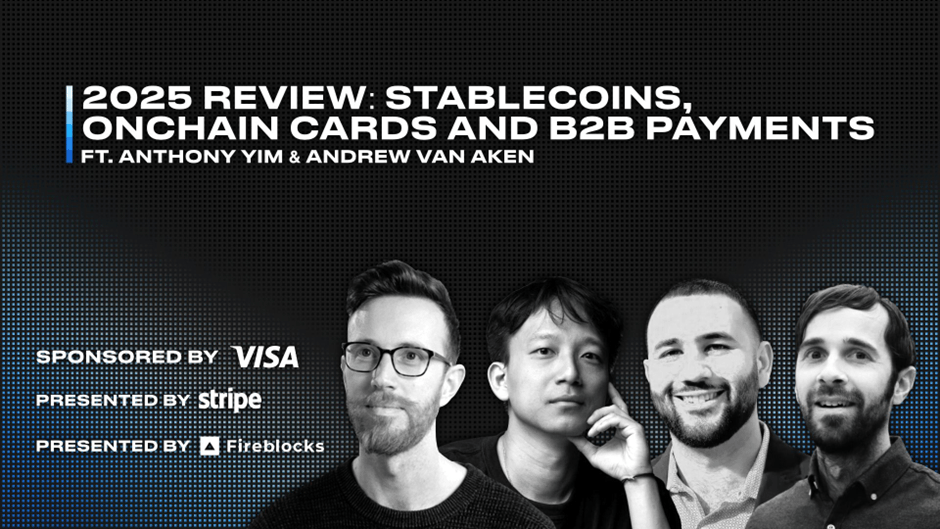
On Ep. 63 of Tokenized, Simon Taylor, GTM @ Tempo and Cuy Sheffield, Head of Crypto @ Visa, are joined by Anthony Yim, Co-Founder @ Artemis and Andrew Van Aken, Data Scientist @ Artemis to discuss stablecoins, onchain cards and B2B payments in their 2025 review.

Simon Taylor
December 30, 2025
If you're reading this and still haven't signed up, click the subscribe button below!
In Episode 63 of Tokenized, our hosts Simon Taylor and Cuy Sheffield welcome two guests from onchain analytics firm Artemis for a data-driven 2025 year in review:
Anthony Yim, Co-Founder, Artemis – former founding engineer at Venmo with deep expertise in payments infrastructure
Andrew Van Aken, Data Scientist, Artemis – leading the firm's stablecoin payment analytics efforts
🎙️Listen to the full episode here on your favorite podcast app or 📷 watch on YouTube.
Key Takeways
Stablecoin supply is fragmenting rapidly, but concentration remains. The number of stablecoins above $10 million in supply has grown from roughly 60 to over 140 in 2025, yet Tether added nearly $50 billion in supply, "almost as much supply as everyone else combined," according to Sheffield.
While Western Union, Klarna, and others have announced stablecoins that haven't launched yet, the data shows 93% of stablecoins above $10 million remain USD-denominated.
The proliferation raises fundamental questions: As Sheffield observed, "when does it make sense to create your own versus to partner and use an existing one?"
The stablecoin taxonomy is breaking down. The episode surfaced an emerging industry challenge around definitions. As Taylor noted, "We call a lot of things a stablecoin that are not stablecoins." He outlined emerging categories: onchain collateral products like Ethena's USDe, traditional fiat-backed issuers like Tether and Circle, and sub-issuance platforms like M0, Agora, and Bridge that allow branded tokens backed by shared reserves.
For corporate treasuries, Taylor argued the appeal is straightforward: "If somebody ran a corporate treasury and you gave them a new technology that allowed them to collect the yield and move it across borders 24/7, they'd want that thing. We happen to call that thing stablecoins."
Tron's network effects prove resilient despite competitive pressure. Despite numerous chains pivoting toward payments use cases, Tron added $19 billion in stablecoin supply in 2025.
Cuy pointed to the network's embedded position in emerging markets: "It went from most people in the US had no idea what Tron was, then they discovered a lot of people are using USDT on Tron in emerging markets."
Simon framed it as "two worlds emerging" - Western distribution increasingly on Solana, while "for everywhere else, it's Tron, Tether... in the UAE, that's the default. In Hong Kong, that's the default."
B2B payments represent the fastest-growing stablecoin vertical, but the path to trillion-dollar scale remains unclear. Artemis data with over 40 partners shows approximately $10 billion in monthly stablecoin payments - roughly $120 billion annualized.
Sheffield noted that early B2B growth comes "despite not really having privacy... and not really having great ERP integrations," suggesting adoption is driven by smaller, mid-market businesses where the improvement over existing solutions justifies onboarding friction.
Taylor argued there's no single killer feature holding back broader adoption, rather "1,000 paper cuts" around fraud screening, sanctions, mainframe integration, and vendor support.
Onchain lending is emerging as a neo-bank enabler. Loans outstanding have grown from $10 billion to the $25-30 billion range in 2025, with over $200 billion in stablecoin-denominated loans originated through smart contracts.
Taylor sees this as a structural opportunity: "If I was a neo-bank that did not have a banking charter, did not intend to use my balance sheet for lending... now you're seeing this alternative model where they can just have this off-the-shelf product that gives their customers yield on one side, but lets them borrow on the other."
Sheffield advocated for reframing industry terminology: "I still hate the term DeFi... we like to say onchain lending, or onchain credit."
Deposits and stablecoins will coexist, not compete. Taylor offered a framework for institutional audiences: "Deposits are money at rest, and stablecoins are money that moves. Stablecoins can be a really efficient rail for banks, and deposits can be a really useful thing for the stablecoin ecosystem."
He emphasized that efficiency gains must be weighed against risk management: "The problem with efficiency sometimes is - what happens if the other guy doesn't have the money? It's all the edge cases that really are where the cost is in the system."
Looking ahead: Yim offered a sobering 2026 prediction: "There will be a bunch of stablecoin blow-ups" as products mislabeled as stablecoins fail to maintain their peg, and founders "underestimate how hard it is actually to get real volume and real liquidity."
Meanwhile, the next 12-24 months will see major neo-banks and payments companies "getting their wheels in motion" on stablecoin infrastructure, setting up what Sheffield described as a significant unlock for institutional on/off-ramps.
Thanks so much for reading the Tokenized Newsletter!
Please share this edition or share it with your colleagues if you enjoyed it!
Disclaimers
This newsletter is for informational purposes only and is not financial, business or legal advice. These thoughts & opinions and do not represent the opinions of any other person, business, entity or sponsor. Any companies or projects mentioned are for illustrative purposes unless specified.
The contents of this newsletter should not be used in any public or private domain without the express permission of the author.
The contents of this newsletter should not be used for any commercial activity, for example - research report, consultancy activity, or paywalled article without the express permission of the author.
Please note, the services and products advertised by our sponsors (by use of terminology such as but not limited to; supported by, sponsored by, Made Possible by or brought to you by) in this newsletter could carry inherent risks and should not be regarded as completely safe or risk-free. Third-party entities provide these services and products, and we do not control, endorse, or guarantee the accuracy, efficacy, or safety of their offerings.
It's crucial to provide our readers with clear information regarding the inherent nature of services and products that might be covered in this newsletter, including those advertised by our sponsors from time to time. When you buy cryptoassets (including NFTs) your capital is at risk. Risks associated with cryptoassets include price volatility, loss of capital (the value of your cryptoassets could drop to zero), complexity, lack of regulation and lack of protection. Most service providers operating in the cryptoasset industry do not currently operate in a regulated industry. Therefore, please be aware that when you buy cryptoassets, you are not protected under financial compensation schemes and protections typically afforded to investors when dealing with regulated and authorised entities to operate as financial services firm.